The browser you are using is not supported. Please consider using a modern browser.


Comprehensive Guide to Community Solar in Massachusetts
Residents can save up to 10% on their electricity bill through a community solar program. Learn how Massachusetts community solar works, how to enroll, and how to compare MA community solar providers.

Key Takeaways
- Massachusetts residents, renters, and business owners can subscribe to a local off-site solar farm without installing panels, paying upfront fees, or taking on maintenance.
- Subscribers earn solar credits applied directly to their electric bill, which typically reduces overall annual electricity costs by 5% to 15%.
- Programs generally offer flexible, short- to medium-term agreements with no cancellation fees (with simple advance notice), allowing easy participation without long-term commitment.
- Community solar in Massachusetts is backed by state clean energy incentives like the SMART program, community solar expands access to local renewable power regardless of home ownership or roof condition.
Table of Contents

If you live in Massachusetts and your electric bill is starting to look like box seats at Fenway Park, community solar might be your new best friend.
Community solar in Massachusetts gives renters, homeowners, condo owners, and businesses a way to support local clean energy and lower electricity costs without the commitment of installing rooftop panels.
Instead, you subscribe to a share of a local solar farm. That solar farm sends electricity to the grid. You receive credits on your electric bill. Keep reading to see how Massachusetts community solar works, how to qualify, how much you can save, and how to compare MA community solar providers.
What Is Community Solar in Massachusetts?
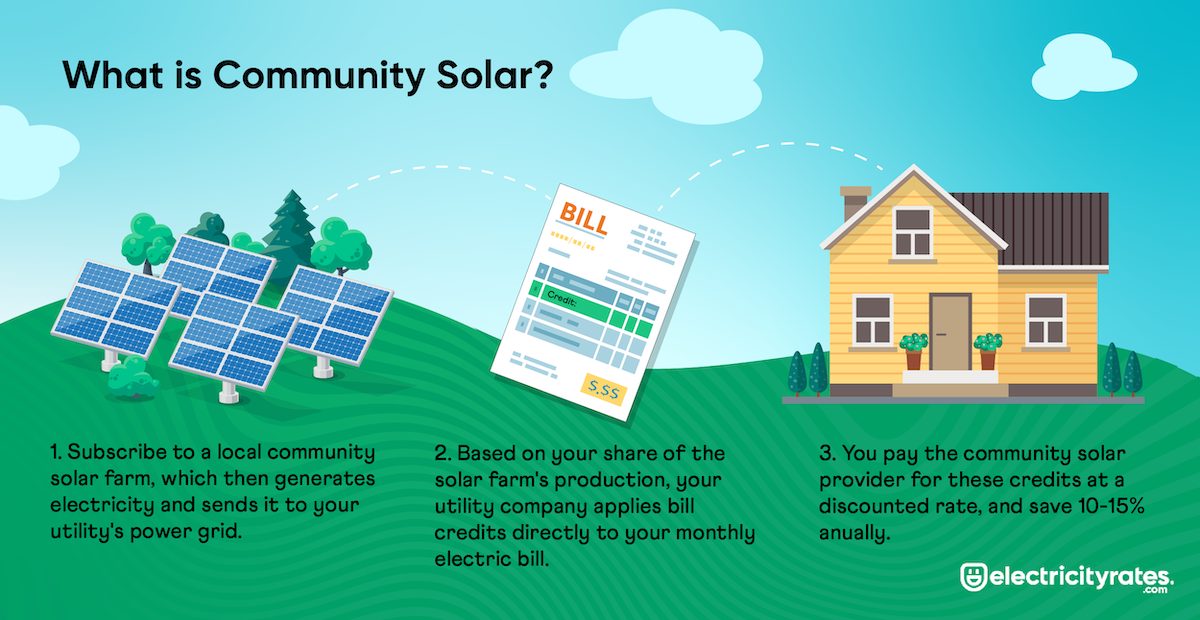
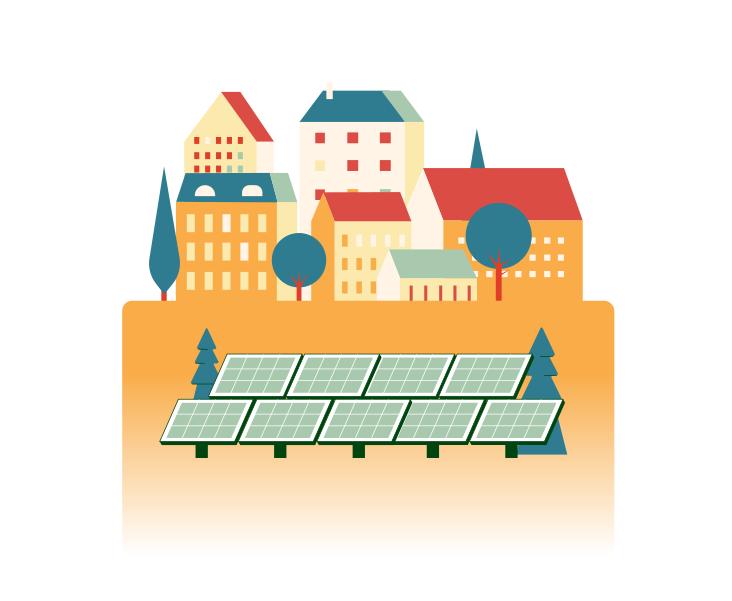
Community solar in Massachusetts is a clean energy program that allows multiple customers to share the benefits of a single off-site solar farm.
You subscribe to a portion of the community solar project. Solar energy is fed into the electric grid. Your utility applies credits to your bill based on your share of the project.
In Massachusetts, this is often called Community Shared Solar, or CSS. Mass.gov describes community solar as a way for people who cannot install solar on their own property to access solar energy.
Here’s the important part you must understand. With community solar programs, you do not switch your utility company.
Your local electric utility still delivers power, maintains the lines, and handles outages. For example, if you are with National Grid, Eversource, or Unitil, that utility still plays its normal role. Your community solar provider manages your solar subscription and bill credits via Virtual Net Metering (VNM). Meaning you won’t experience any service disruptions.
What Are the Benefits of Community Solar?
-
Supports Massachusetts Solar Energy Goals
Massachusetts has a statewide goal of reaching net-zero greenhouse gas emissions by 2050. Community solar helps expand local solar generation, which supports the shift away from fossil fuels.
-
Universal Accessibility
Not every home is ready for solar panels, and community solar removes those barriers. Customers can benefit from solar without owning equipment, installing panels, or changing how electricity reaches their home.
-
Guaranteed Financial Savings
Most state programs feature a “guaranteed savings” structure, ensuring that the solar credits received are consistently valued at a price higher than the subscription cost.
-
Local Economic Growth
Community solar projects also support local clean energy jobs, lease income for landowners, and tax revenue for host towns. It’s a win-win for the local economy and the environment.
How Much Can I Save With Massachusetts Community Solar?
Community solar savings matter in Massachusetts because electricity costs are often higher than the national average. The average Massachusetts household uses 570 kWh per month at a rate of 28.82 cents per kilowatt-hour. This adds up to $167 per month for electricity.
Typical savings from community solar can vary:
- Standard subscribers generally see savings between 5% to 20%, depending on the project.
- Low-to-moderate-income customers may qualify for stronger bill savings through certain SMART projects.
- For an average Massachusetts household, that could mean roughly $96 to $400 in annual savings depending on usage and discount level.
Community solar is not the same as switching electricity suppliers, but the two can both be part of your savings strategy. Keep reading to see how to double down your electricity savings by combining a community solar plan with an affordable electricity supplier.


How to Sign Up for Community Solar in Massachusetts
Sign Up in a Few Easy Steps
Step 1. Check Your Utility Eligibility: Most community solar projects require you to be in the same utility territory as the solar farm. In Massachusetts, that often means National Grid, Eversource, or Unitil service areas.
Step 2. Compare Available Projects: Look for projects in your utility area. Availability changes often, so waitlists are common. Have a recent electric bill ready. Your provider may need your account number, utility provider, service address, and average monthly usage.
Step 3. Enroll Online: Most providers allow online enrollment. Review the contract and the terms before signing.
Step 4. Watch for Credits: Once your project is active and your utility processes the subscription, credits usually appear within 1 to 3 billing cycles. Some projects may take longer if they are still under construction.
How to Know if Community Solar Is Right for You
Community solar in MA may be a smart fit if:
- You rent your home or apartment.
- You own a condo or live in a multi-family building.
- Your roof is old, shaded, small, or facing the wrong direction.
- You want solar savings without installation costs.
- You want to support Massachusetts solar energy.
- You want a simpler option than buying rooftop panels.
It may not be the best fit if:
- You already have rooftop solar.
- Your town is served by a Municipal Light Plant that does not support virtual net metering or eligible community solar credits.
- You plan to move soon, and the provider does not offer easy transfer or cancellation.
Community solar is also different from a renewable electricity plan. These types of plans can support renewable energy from different sources, while community solar is tied to a local solar project. Solar power options can include rooftop panels, batteries, and community solar depending on your home and goals.
History of Community Solar in Massachusetts
Massachusetts has been early to a lot of things. American Revolution. Dunkin loyalty. Saying “wicked” before it became mainstream. It was also early in community solar.
Massachusetts passed its first community solar legislation in 2008. Early growth was supported by net metering rules and solar renewable energy certificates (SRECs) which rewarded developers based on generation and land-use attributes.
Then came a major shift.
In 2018, Massachusetts launched the Solar Massachusetts Renewable Target program, better known as SMART. This program created a more structured incentive system for solar projects, including Community Shared Solar.
Massachusetts does not have one simple stand-alone “community solar law.” Instead, community solar rules are built into the broader SMART solar incentive program.
SMART has continued to evolve. SMART 3.0 became effective in September 2025 and includes an additional 15% discount for low-income households and guaranteed savings for certain residential subscribers.
Community Solar Providers in Massachusetts
Community solar availability depends on where you live and your utility territory. Providers may also have waitlists.
Arcadia

- Provider Score™ 4.63 / 5
- Energy Options
- Service Areas DC, DE, IL, MA, MD, NJ, NY, RI, VA
Provider Bio
Founded in 2014 with the mission to democratize clean energy, Arcadia grew to become the nation's largest manager of community solar by bridging the gap between consumers and renewable energy developers. The company has expanded their reach of putting clean energy into the grid across numerous states, and preventing billions of pounds of coal from being burned annually. Arcadia's core value proposition lies in making renewable energy universally accessible and affordable; it allows renters and homeowners alike to support local solar farms without upfront costs or rooftop installations, while guaranteeing a 5% to 15% savings on their electricity bills.
Nexamp
- Provider Score™ 4.63 / 5
- Energy Options
- Service Areas IL, MA, MD, NJ, NY
Provider Bio
Founded in 2007 by two U.S. Army veterans, Nexamp has grown into a leading clean energy provider dedicated to democratizing solar power. By developing and managing extensive networks of distributed solar farms and energy storage systems across the country, the company plays a pivotal role in accelerating the transition to a modern, renewable grid. Their core value proposition lies in making sustainability accessible and affordable, allowing homeowners, renters, and small businesses to subscribe to a local solar project and save an average of 10% to 15% on electricity costs without any rooftop installation, sign-up fees, or long-term commitments.
Perch Energy
- Provider Score™ 4.7 / 5
- Energy Options
- Service Areas DC, MA, MD, NJ, NY
Provider Bio
Perch Community Solar acts as a major bridge to renewable energy by allowing renters, homeowners, and businesses to subscribe to local solar farms without needing to install rooftop panels. By managing more than 3 gigawatts (GW) of solar capacity across over 1,000 projects nationwide, the company has successfully driven the generation of over 6.6 billion kWh of clean power directly into the electric grid. This massive injection of renewable energy significantly diversifies local power supplies, cuts down reliance on fossil fuels, and accelerates the transition toward a cleaner, more resilient energy infrastructure.
Solstice

- Provider Score™ 4.7 / 5
- Energy Options
- Service Areas IL, MA, NJ, NY, VA
Provider Bio
Solstice Community Solar is a purpose-driven organization dedicated to democratizing clean energy by connecting households, renters, and businesses to local, shared solar farms without requiring rooftop installations. By expanding access to historically underserved and low-to-moderate-income communities through inclusive qualifying metrics like their proprietary EnergyScore, Solstice helps scale the adoption of renewable energy. This community-centered model has successfully funneled over 100 megawatts of clean electricity directly into the local power grid, significantly lowering carbon emissions while providing millions of dollars in collective utility bill savings.
What to Expect With Your New Solar Bills
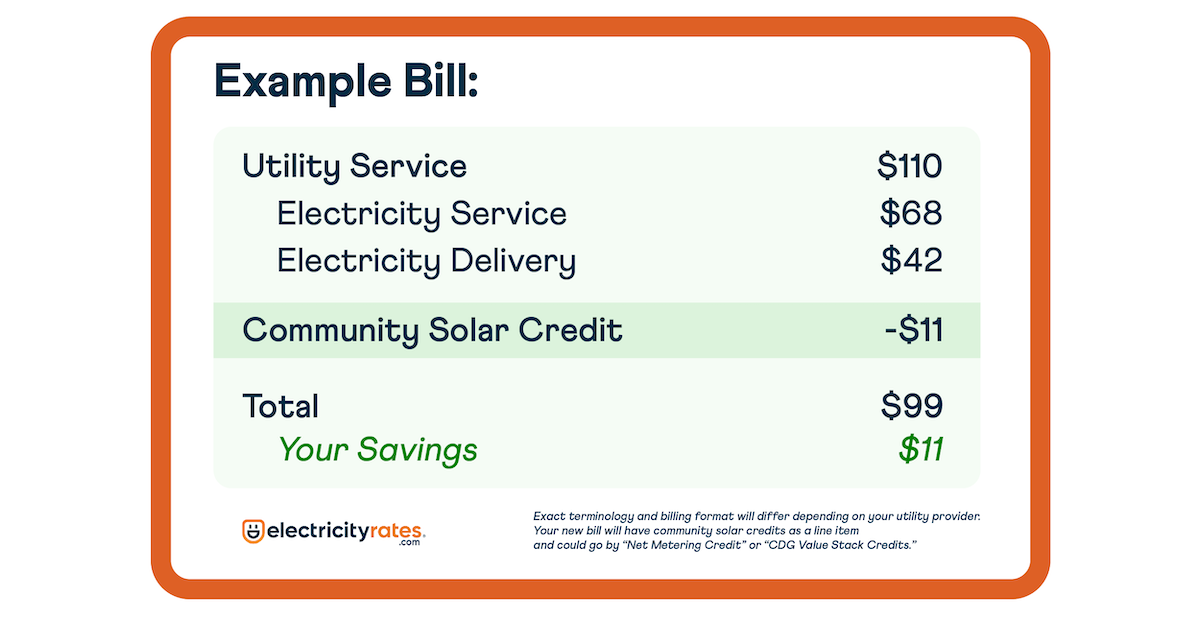
In Massachusetts, there is what’s called Universal Consolidated Billing (UCB). This means that, as a community solar subscriber, you simply receive your regular utility bill from National Grid, Eversource or Unitil and it’ll just have an additional section or line item showing your solar farm credits and how much they’re offsetting your total cost. UCB is the preferred method within the industry and makes it seamless for you, as the subscriber. That’s because you don’t need to do anything differently.
How to Find and Compare Community Solar Near You
Comparing MA community solar options is the best way to maximize your savings. Here’s how to get started:
- Visit ElectricityRates.com: Use our community solar guides to explore providers, compare offers, and understand the fine print.
- Look for Key Features: Including savings rate (10–20% is typical), contract length, and billing structure (two bills vs. consolidated)
- Sign Up for Available Projects: Some areas have immediate availability, while others operate on a waitlist. Joining a waitlist is free and places you in line for the next open project.
Massachusetts community solar gives residents and businesses a practical way to support local clean energy and lower electric bills without rooftop panels.
It is not as dramatic as tossing tea into Boston Harbor, but it may be a cleaner way to start a small energy revolution at home. You can also pair community solar with the most affordable electricity rate available using ElectricityRates.com’s comparison tools. To double down on energy savings, enter your ZIP Code for a side-by-side comparison of the best electricity rates and electricity providers in Massachusetts.
Massachusetts Community Solar FAQs
-
Yes. Community solar, also called Community Shared Solar, is supported through Massachusetts solar policy and the SMART program. Always choose a reputable provider and read the contract before enrolling.
-
Yes. Renters can often join if they pay their own electric bill and live in an eligible utility territory.
-
No. Community solar uses an off-site solar farm, so there is no equipment to install or maintain at your home.
-
No. Your utility still delivers electricity and maintains the lines. Community solar adds bill credits tied to your share of an off-site solar project.
-
In many cases, yes. Community solar affects solar credits on your bill, while switching suppliers affects your electricity supply rate. Review your provider terms to confirm.
-
Savings vary, but many Massachusetts community solar programs offer around 5% to 15% savings. Some programs may offer more, especially for eligible low-income customers.
-
Yes. Community solar projects can qualify through the SMART program. Subscribers usually benefit through bill credits and discounts, while the project owner receives the direct solar incentive.
-
Yes. Businesses may be able to subscribe to community solar if they have an eligible electric account and match with an available project in their utility territory.