The browser you are using is not supported. Please consider using a modern browser.


How Does Consolidated Billing Work for Community Solar Programs?
Consolidated billing puts your community solar credits and charges on one utility bill. Learn how it works, how it compares to dual billing, and how to enroll in a community solar farm.

Key Takeaways
- Consolidated billing rolls your community solar credits and charges onto your regular utility bill—one bill, one payment, no extra invoices to track.
- The alternative, dual billing, means two bills each month: one from your utility and one from your community solar provider.
- Either way, you save the same amount. Consolidated billing just makes those savings much easier to see (and much harder to forget to pay for).
- Availability depends on your state and utility. Regulators in a growing number of states are pushing consolidated billing to make community solar simpler for everyone.
Table of Contents

What is Consolidated Billing for Community Solar?
Consolidated billing, often called utility consolidated billing or UCB, means everything related to your community solar subscription lives on a single bill: your regular utility bill. Your normal electricity charges, your solar credits, and the discounted cost of those credits all appear as line items on the one statement you were already getting.
One bill. One payment. One place to see exactly what you’re saving.
Consolidated Billing vs. Dual Billing
Not every community solar program offers consolidated billing. It depends on whether your state and utility support it. The alternative is dual billing (also called the two-bill system), and as community solar providers like Solstice point out, it’s still the more common setup in many markets.
- Consolidated billing: Your credits and your charges both appear on your utility bill. You make one payment to your utility, and you’re done.
- Dual billing: Your credits appear on your utility bill, lowering what you owe your utility. Then, usually one to three months later, your community solar provider sends a separate invoice charging you for those credits at the discounted rate. You save the same amount overall, but the savings are split across two bills that don’t arrive at the same time, which can make the math feel murkier than it is.
Here’s how they stack up side by side:
| Consolidated Billing | Dual Billing | |
|---|---|---|
| Number of Bills | One (your utility bill) | Two (utility bill + solar provider invoice) |
| Payment Flow | Pay your utility once; the utility settles with the solar provider | Pay your utility, then pay the solar provider separately |
| Clarity of Savings | Credits and discounted charges sit side by side on one statement | Savings are split across two bills, often arriving in different months |
| Auto-pay | Works seamlessly—one payment, no changes to your routine | Requires setting up auto-pay with two separate companies |
To be clear: dual billing customers save just as much money. If your usual bill is $100 and you earn $50 in credits at a 20% discount, you’ll pay your utility $50 and your solar provider $40—$90 total, $10 saved. It works. It’s just more homework.
How Consolidated Billing Works
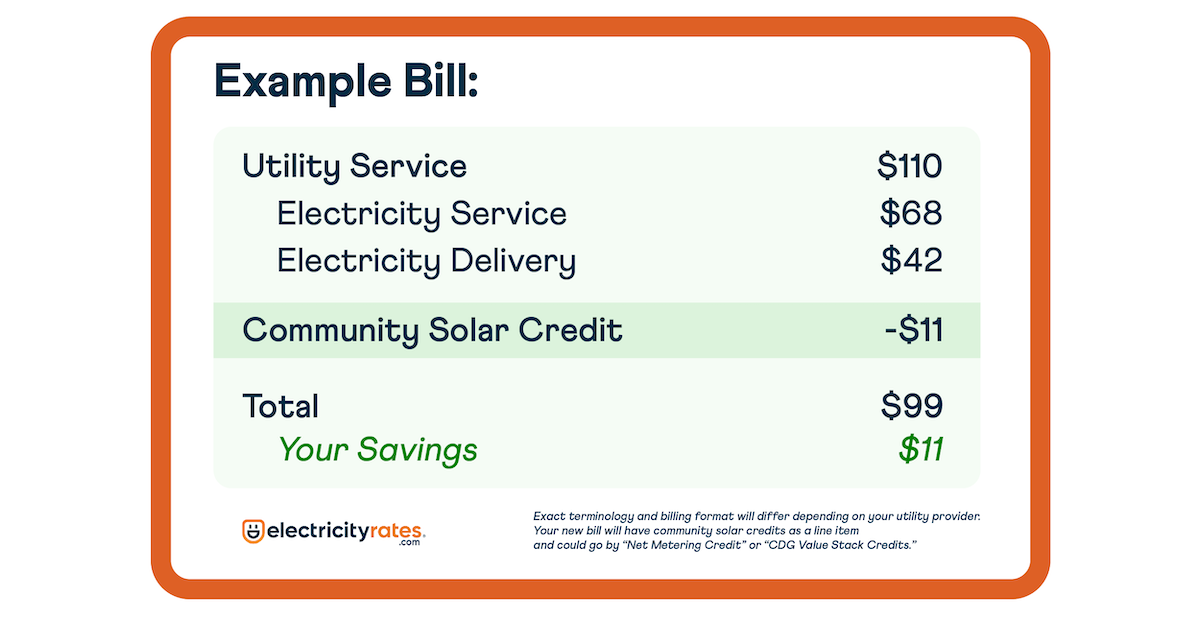
Once your utility approves your enrollment and your solar farm is producing, your monthly utility bill will show a few new line items, as providers like Nexamp explain it:
- Your standard electricity charges—supply and delivery, same as always.
- Your community solar credits—a negative line item that lowers your total, reflecting your share of the solar farm’s production.
- Your community solar charge—a positive line item for the discounted cost of those credits, which the utility passes along to your solar provider.
You pay your utility one total amount, exactly the way you always have. The utility handles settling up with the community solar provider behind the scenes. If you’re on auto-pay, nothing about your routine changes. The savings just show up.
One thing to know: solar production varies by season. Summer months typically generate more credits than you need, and those extra credits roll forward to help offset your winter bills. Judge your savings over a full year, not a single month.
Key Benefits of Utility Consolidated Billing (UCB)
The transition toward consolidated billing—pushed heavily by state regulators and modern utilities—offers perks across the board.
For the Consumer
- Fewer bills to manage. No second invoice to track, no second auto-pay to set up, no second login to remember. Your community solar subscription becomes as low-maintenance as your existing utility service.
- Financial transparency. When your credits and charges appear on the same statement, your savings are right there in black and white. With dual billing, subscribers sometimes wonder whether they’re saving at all—the credit lands one month and the charge for it arrives a month or two later. Consolidated billing closes that gap.
- No out-of-pocket timing gaps. Under dual billing, you might pay your solar provider in June for credits that lowered your April bill. Consolidated billing keeps everything in the same billing cycle, so your cash flow matches your savings—no mental accounting required.
For Community Solar Providers and the Industry
- Lower customer churn. Confusion is the enemy of retention. Subscribers who can’t easily see their savings—or who get frustrated juggling two bills—are more likely to cancel. A single, clear bill keeps subscribers happy and enrolled.
- Reduced soft costs. Providers on dual billing spend real money invoicing customers, chasing late payments, and staffing support lines to explain the two-bill system. Consolidated billing hands the payment mechanics to the utility, letting providers put those resources toward building more solar instead.
- Broader equity and accessibility. Community solar’s promise is clean energy savings for everyone, including renters and lower-income households. Simpler billing removes a genuine barrier: separate invoices and credit-check-style hurdles can shut out the very people community solar is meant to serve. One familiar utility bill makes participation easier and more inclusive.


How to Sign Up for Community Solar
Enrolling in community solar usually takes less time than reading this article:
- Check availability. Enter your ZIP Code to see whether community solar farms in your utility’s territory have open capacity.
- Review the program terms. This includes the discount rate, billing method (consolidated or dual), contract length, and cancellation policy. Many programs—like Perch Energy’s community solar program—have no upfront costs and no cancellation fees.
- Subscribe online. Enrollment typically takes 5–15 minutes. The provider sizes your share to your usage and submits your account to your utility.
- Watch the credits roll in. Activation can take a few billing cycles for credits to start appearing. Keep paying your bill as usual and enjoy the savings once in effect.
One more tip: community solar works alongside your existing electricity plan. In deregulated markets, you can pair a community solar subscription with a competitive fixed-rate plan and save on both sides of your bill. Compare rates on ElectricityRates.com to see what’s available in your area.
Explore Community Solar Programs in Your State
Consolidated Billing FAQs
-
Yes. The discount is identical either way. Consolidated billing just makes your savings easier to see and your payments easier to manage.
-
Ask before you enroll. Availability depends on your state’s regulations and whether your utility has built the billing infrastructure. Your provider can tell you which system applies to your project.
-
Integrating a utility’s billing system with community solar providers takes regulatory approval, technical coordination, and time. Some states haven’t authorized it yet; some utilities are still building it. Regulators in a growing number of states are pushing it forward.
-
No. Your utility, your power lines, and your reliability all stay exactly the same. The only difference is a few new line items on your bill—and a lower total.