The browser you are using is not supported. Please consider using a modern browser.


The Complete Guide to Community Solar in Virginia
Explore how you can save up to 10% on your electricity bill through a Virginia community solar farm. Learn how community solar works, how to enroll and how to find the best provider in your area.

Key Takeaways
- Community solar allows Virginia residents to benefit from solar energy by subscribing to a portion of a local, off-site solar farm, entirely removing the need to buy, install, or maintain rooftop solar panels.
- Subscribers receive monthly energy credits on their utility bills proportional to their share of the solar farm's production, which typically translates to a 5% to 15% reduction in overall electricity costs.
- To streamline the process, the program utilizes a single-bill system; your subscription charges and your community solar credits appear directly on your regular monthly utility statement rather than as separate bills.
- Virginia law strictly mandates that at least 30% of the state's shared solar capacity must be reserved specifically for low-to-moderate-income (LMI) customers, ensuring broader and more equitable access to green energy.
Table of Contents

Virginians, do you want solar power savings without turning your roof into a science fair project? Good news, community solar in Virginia lets you subscribe to a local solar farm, earn bill credits, and support cleaner energy without installing a single panel on your home or business.
In plain English, it is one of the easiest ways for Virginia renters, homeowners, and many small businesses to tap into green solar energy. See below for everything you need to know to start exploring community solar programs in Virginia and save on your energy bill.
Quick Summary: What is Community Solar in Virginia?
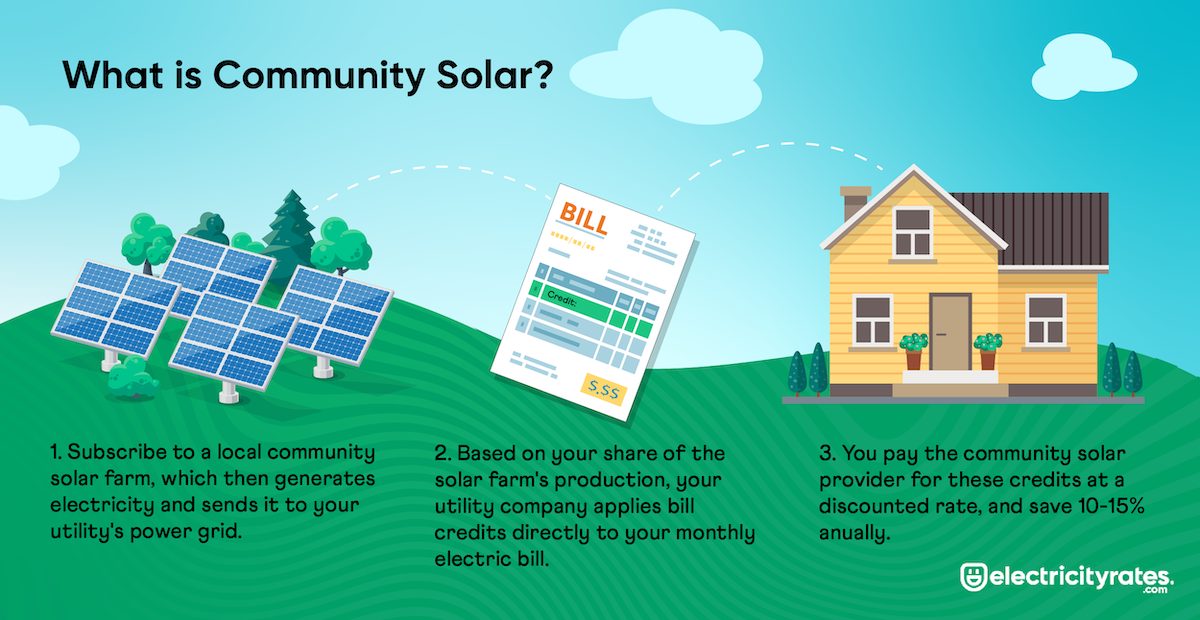
Community solar in Virginia allows eligible customers to subscribe to a share of a nearby solar farm and receive bill credits tied to the electricity generated by that share. The model is especially helpful for renters, people with shaded roofs, plus anyone who wants solar savings without buying and installing rooftop panels. Virginia’s shared solar areas continue to expand in 2026 and beyond, now covering parts of both Dominion Energy and Appalachian Power territory.
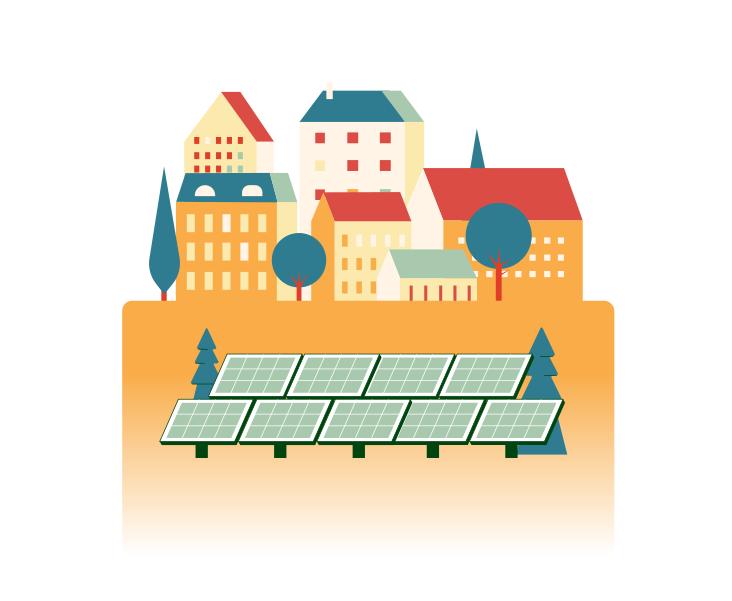
In community solar programs, a group of people shares in the electricity generated by a local solar farm. The model allows multiple customers, such as individuals, businesses, and nonprofits, to benefit from a solar project within a specific region. Customers subscribe to solar panels located off-site. They receive a credit on their electric bill for the electricity produced by the portion of the community solar they own.
Benefits of Community Solar in Virginia
-
Save Money on Your Electricity Bill
The biggest benefit of community solar for Virginians is savings of 10% to 25% annually.
-
Accessibility for All
Community solar is a good option for renters and for customers whose roofs are not suitable for rooftop solar.
-
Cleaner Local Energy & Reduced Carbon Emissions
Community solar helps add more renewable energy to Virginia’s grid, supporting the broader growth of solar energy and local project development.
How Much Can I Save by Joining a Virginia Community Solar Farm?
For many Virginians, “solar incentives” usually means tax credits, rebates, or savings programs. With community solar, the main value is usually not a rooftop tax credit for the subscriber. Instead, the savings usually come through bill credits and discounted subscription structures. That is one reason community solar in Virginia appeals to people who want simpler savings without owning a full solar system.
The exact savings on your electricity bill vary depending on the specific community solar program and the user’s energy consumption, but generally range from 5% to 10% annual savings. If you qualify as a low to moderate income resident then your savings gets bumped to 20% annually.
Important Fine Print Before you Subscribe
Here is the part nobody puts on a movie poster, but it matters.
- Your savings can vary by project and utility billing terms. Community solar savings typically fall in the 10% to 25% range, not one flat number for everyone.
- You usually must live in the same utility territory as the solar project. Your share needs to match the local utility rules, so not every solar farm in Virginia is available to every Virginian.
- Project availability can be limited. Virginia’s initial shared solar capacity has already been allocated, and provider pages stress that enrollment depends on open project space.
- Billing details matter. Some programs use a single utility bill with built-in credits, while others may involve separate invoicing. Always check the enrollment terms.
- Contract terms may differ. DOE’s community solar consumer guidance emphasizes plain-language disclosures and says strong community solar programs should avoid sign-up, exit, and termination fees.


How to Sign Up for Community Solar in Virginia?
Sign Up in a Few Easy Steps
1. Check Your Eligibility: Make sure you live in the Dominion Energy or Appalachian Power service territory. These utilities currently support the broadest range of community solar options.
2. Compare Available Providers: Providers vary in savings rates, subscription terms, and project availability.
3. Enroll Online: Most providers offer quick sign-ups requiring your utility account number, basic contact information, and payment method for your discounted solar credits.
4. Wait for Project Activation: If a solar farm is already generating electricity, you may begin receiving credits within 1-3 months.
5. Start Receiving Monthly Savings: Once active, your utility bill will show your solar credits, and your provider will send a separate solar credit invoice each month.
How to Know if Community Solar Is Right for You
Deciding if community solar is the right choice involves considering several factors. If you live in Virginia and lack a suitable roof for solar panels, or if you’re a renter, community solar offers a practical solution to participate in renewable energy. It’s also worth considering if you’re looking for ways to lower your electricity bills while supporting local renewable energy projects. Comparing VA community solar companies and plans is necessary to find the best fit for your energy needs and financial goals.
What Is the Difference Between Community Solar and Green Energy Plans?
While both community solar and green energy plans aim to increase the use of renewable resources, there are key differences. Community Solar in Illinois focuses on sharing the output of a local solar farm among community members, directly connecting consumers with their energy source. Green energy plans, on the other hand, may source electricity from a variety of renewable sources, which may not necessarily support local jobs or energy independence.
What is the Difference Between Community Solar and Rooftop?
Rooftop solar systems require homeownership and a significant upfront investment. They offer personal energy production and the potential for increased property value. In contrast, community solar is an accessible alternative that doesn’t require property ownership, upfront costs, or suitable roofing conditions. It is more inclusive and appeals to a broader range of people.
With community solar, participants share the energy production, contributing to sustainability without the logistical and financial commitments of rooftop installations. The decision between the two options depends on individual circumstances, such as financial readiness, property suitability, and personal preferences for energy independence or community participation. Both choices promise to use renewable energy but cater to different needs.
Community Solar Companies in Virginia
Virginia residents have multiple reputable community solar providers to choose from. All of these providers operate community solar programs across multiple states and committed to providing accessible clean energy. It is important to note that program availability is based on your location, utility and capacity of the provider. Depending on these factors you may have immediate access to enroll or be wait listed until a new farm open up.
Arcadia

- Provider Score™ 4.63 / 5
- Energy Options
- Service Areas DC, DE, IL, MA, MD, NJ, NY, RI, VA
Provider Bio
Founded in 2014 with the mission to democratize clean energy, Arcadia grew to become the nation's largest manager of community solar by bridging the gap between consumers and renewable energy developers. The company has expanded their reach of putting clean energy into the grid across numerous states, and preventing billions of pounds of coal from being burned annually. Arcadia's core value proposition lies in making renewable energy universally accessible and affordable; it allows renters and homeowners alike to support local solar farms without upfront costs or rooftop installations, while guaranteeing a 5% to 15% savings on their electricity bills.
Nexamp
- Provider Score™ 4.63 / 5
- Energy Options
- Service Areas IL, MA, MD, NJ, NY
Provider Bio
Founded in 2007 by two U.S. Army veterans, Nexamp has grown into a leading clean energy provider dedicated to democratizing solar power. By developing and managing extensive networks of distributed solar farms and energy storage systems across the country, the company plays a pivotal role in accelerating the transition to a modern, renewable grid. Their core value proposition lies in making sustainability accessible and affordable, allowing homeowners, renters, and small businesses to subscribe to a local solar project and save an average of 10% to 15% on electricity costs without any rooftop installation, sign-up fees, or long-term commitments.
Solstice

- Provider Score™ 4.7 / 5
- Energy Options
- Service Areas IL, MA, NJ, NY, VA
Provider Bio
Solstice Community Solar is a purpose-driven organization dedicated to democratizing clean energy by connecting households, renters, and businesses to local, shared solar farms without requiring rooftop installations. By expanding access to historically underserved and low-to-moderate-income communities through inclusive qualifying metrics like their proprietary EnergyScore, Solstice helps scale the adoption of renewable energy. This community-centered model has successfully funneled over 100 megawatts of clean electricity directly into the local power grid, significantly lowering carbon emissions while providing millions of dollars in collective utility bill savings.
Why Community Solar Matters in Virginia
Guided by the Virginia Clean Economy Act, the Commonwealth is undergoing a historic transition toward a 100% carbon-free grid by 2045–2050. Community solar gives more people access to that shift, especially people who cannot install their own solar systems. That matters even more in a state like Virginia, where residential electricity use is roughly 15% higher than the national average and state energy use exceeds energy production.
There is real momentum behind the Virginia community solar market. Virginia’s shared solar industry is currently capped at 200 megawatts (MW) across 52 projects (each <5 MW). State lawmakers authorized an additional 150 MW in 2024, but over a dozen projects await approval. Delegate Rip Sullivan proposed legislation (HB807) to allow 525 more MW with the ability to expand without further General Assembly approval, and his bill passed the House of Delegates in March 2026.
What to Expect With Your New Solar Bills
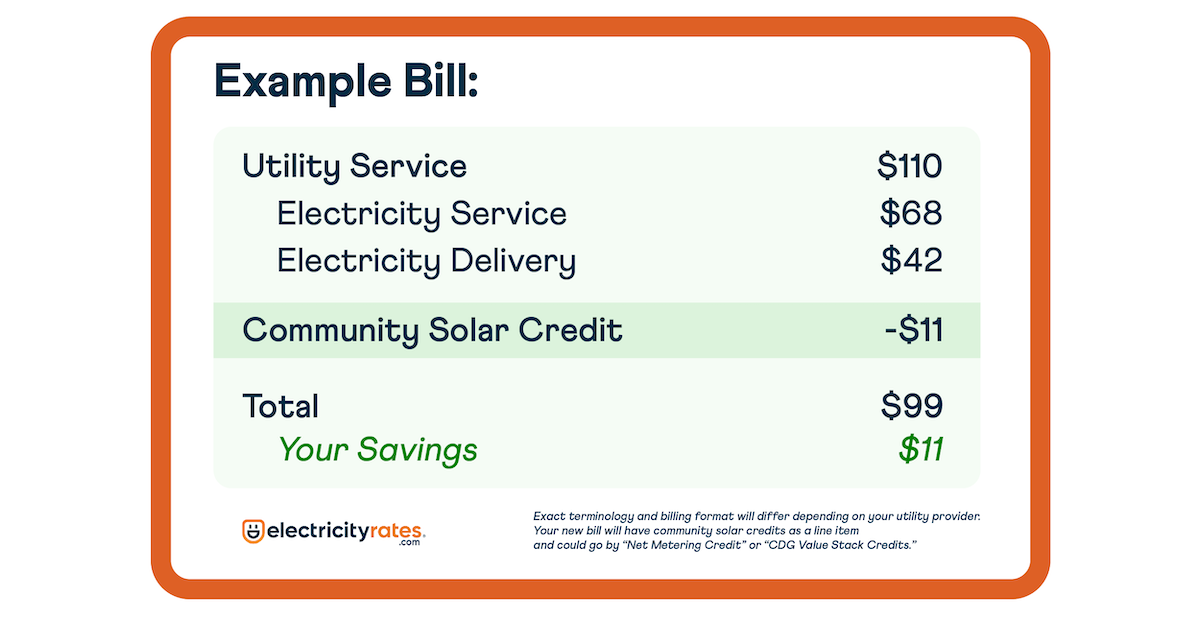
In Virginia, there is what’s called Universal Consolidated Billing (UCB). This means that, as a community solar subscriber, you simply receive your regular utility bill from Dominion Energy or Appalachian Power and it’ll just have an additional section or line item showing your solar farm credits and how much they’re offsetting your total cost. UCB is the preferred method within the industry and makes it seamless for you, as the subscriber. That’s because you don’t need to do anything differently.
How to Choose Among Solar Companies in Virginia
Comparing Virginia community solar options is the best way to maximize your savings. Here’s how to get started:
- Visit ElectricityRates.com: Use our community solar guides to find available projects in your utility territory, compare offers, and understand the fine print.
- Look for Key Features: Subscribe based on your usage. Compare your savings rate (10–20% is typical), contract details, and billing structure.
- Sign Up for Available Projects: Some areas have immediate availability, while others operate on a waitlist. Joining a waitlist is free and places you in line for the next open project.
Community solar in Virginia is one of the easiest ways to benefit from solar power without buying rooftop panels, managing installation, or becoming best friends with a home contractor. It gives many Virginia residents and business owners a simpler path to lower bills, cleaner energy, and a more flexible entry point into the state’s growing solar market.
If you want to explore your options, enter your ZIP Code to compare solar choices in your area through our expert-vetted marketplace and solar resources.
Virginia Community Solar Frequently Asked Questions
-
No. Community solar works through an off-site solar farm in Virginia, so there is nothing to install on your house, apartment, or business.
-
Yes, that is possible. Talk to your landlord about joining a Virginia community solar program.
-
Yes. Your utility still delivers your electricity and maintains service. Community solar changes how credits appear on your bill, not who owns the poles and wires.
-
It depends on the project, your usage, and the billing structure, but ElectricityRates.com says many community solar participants save around 10% to 15% annually, and some Virginia-specific offers reference up to 25% savings.
-
No. Availability depends on utility territory, project capacity, and whether there is open enrollment in your area.