The browser you are using is not supported. Please consider using a modern browser.


How to Compare National Grid Electricity Rates

Key Takeaways
- Your bill is split into delivery charges (fixed costs for grid maintenance) and supply charges (the cost of electricity used). Through Energy Choice, you can switch to a third-party supplier to potentially lock in lower rates or choose 100% renewable energy plans.
- Low-to-moderate-income households can access monthly bill credits through programs like EAP and HEAP. Additionally, all customers can save via instant rebates on energy-efficient appliances through the National Grid Marketplace or high-value incentives (up to $4,000+) for heat pump installations.
- Renters and homeowners can save 5%–15% on their monthly bills without installing rooftop panels by subscribing to local community solar farms. These programs provide guaranteed bill credits and support New York’s transition to a zero-emission power grid by 2040.
- National Grid is investing roughly $35 billion into infrastructure and "energy highways" to meet New York’s goal of 70% renewable electricity by 2030. This includes programs like ConnectedSolutions, which pays customers to adjust energy use during peak demand.
Table of Contents
How to Read Your National Grid Bill
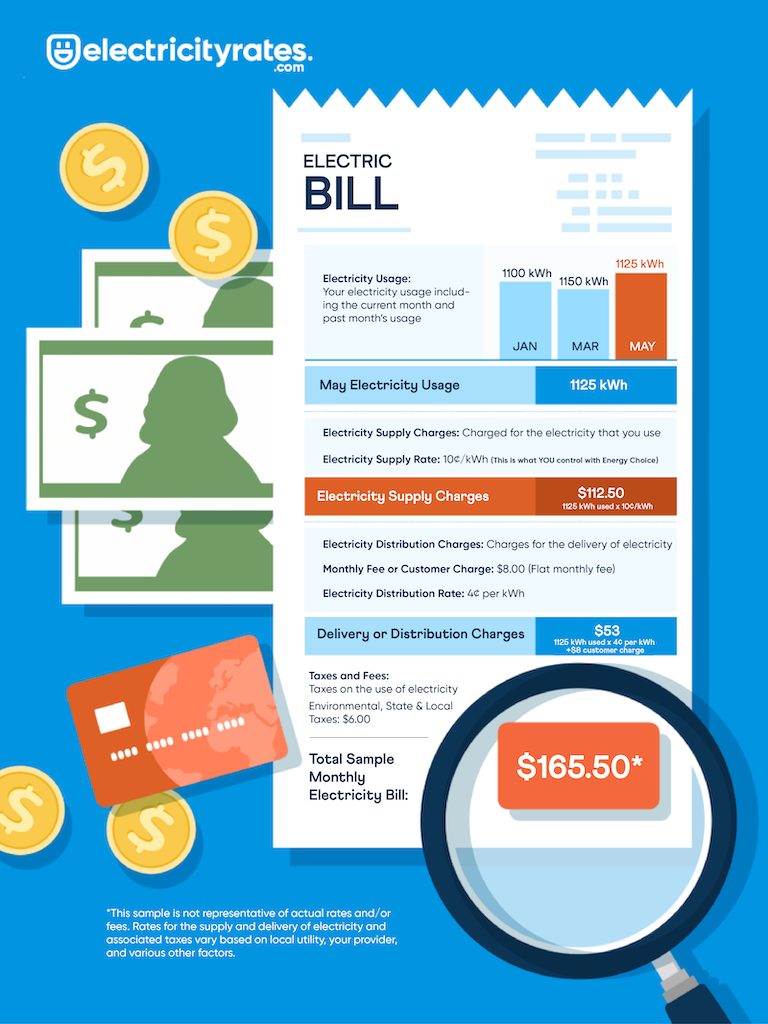
On your National Grid electricity bill, there are two types of charges: delivery charges and supply charges. When you take advantage of Energy Choice and switch electricity providers, you are taking control of your electricity supply charges.
- Supply charges are for the electricity that you use every month and are charged by the kilowatt-hour (kWh). If you haven’t selected an alternative supplier, these charges will be based on National Grid’s Standard Service rate.
- Delivery charges come from National Grid For the safe and reliable delivery of electricity to your home. These charges are set by National Grid and approved by the New York State Public Services Commission, and they remain the same regardless of your chosen supplier.
Ways to Save Money on Your National Grid Electricity Bill
National Grid offers a variety of ways to lower your monthly costs, ranging from direct bill credits for income-eligible households to “instant” rebates on energy-efficient appliances. Here is a breakdown of how you can save:
1. Direct Bill Assistance & Grant Programs
If you are struggling to keep up with payments, these programs provide direct financial relief:
- Energy Affordability Program (EAP): This program provides a monthly bill credit to low-to-moderate income households. Enrollment is often automatic if you receive HEAP, SNAP, or Medicaid, but you can also self-enroll by submitting an application.
- Enhanced Energy Affordability Program (EEAP): A newer program (expanded in 2026) for customers who fall just above the traditional EAP income limits but still need assistance.
- Home Energy Assistance Program (HEAP): A federal grant that helps pay for heating costs. Regular HEAP benefits can be several hundred dollars per year, and Emergency HEAP is available if you are in danger of a shut-off.
- Care & Share / Project Warmth: These are community-funded grants (often managed by the United Way) for customers facing temporary financial hardships who may not qualify for government aid.
2. Rebates and Incentives
National Grid offers cash back and instant discounts for upgrading to more efficient technology:
- NYS Clean Heat Program: Significant rebates (often $4,000+) for installing air-source or ground-source heat pumps.
- National Grid Marketplace: You can get instant rebates (no paperwork needed) on smart thermostats, LED lighting, and advanced power strips by shopping directly through their online store.
- Appliance Rebates: Cash-back offers for purchasing ENERGY STAR® certified clothes dryers ($50), refrigerators, and water heaters.
- Weatherization: Depending on your location and income, you may qualify for free or low-cost energy audits and professional insulation/air sealing services.
3. Energy Saving Initiatives
You can earn money or lower your usage through these active programs:
- ConnectedSolutions (Battery/Thermostat): You can earn an average of $250/year by allowing National Grid to briefly adjust your smart thermostat or discharge your home battery system during times of peak summer demand.
- Customer Electrification Program: In specific neighborhoods, National Grid offers to cover up to 100% of the cost for customers to switch from gas to electric appliances to help modernize the local grid.
- Budget Plan: While this doesn’t reduce your total cost, it levels out your payments into 12 equal monthly amounts, preventing high “peak” bills during the winter or summer.
New York’s Clean Energy Future
Like all major utilities in the state, National Grid is operating under the mandates of the Climate Leadership and Community Protection Act (CLCPA), which requires New York to reach 70% renewable electricity by 2030 and a zero-emission power grid by 2040. To meet these requirements, National Grid has launched its own “fossil-free” strategy, committing to a multi-billion dollar investment—approximately $35 billion across its New York and Massachusetts territories—to modernize the energy delivery system.
To support the state’s large-scale renewable goals, National Grid is investing in transmission upgrades that act as “energy highways,” moving power from massive offshore wind farms and upstate solar arrays to high-demand areas. By 2050, National Grid aims to achieve net-zero emissions, placing a heavy emphasis on “targeted electrification” and energy efficiency programs. These initiatives are paired with state-backed Regional Clean Energy Hubs, designed to ensure that disadvantaged communities have equitable access to clean energy jobs and affordable technology upgrades.
Community Solar Options in New York
Community solar allows multiple participants—including renters, homeowners, and small businesses—to share the benefits of a single, off-site solar array. These projects are built within National Grid’s service territory and feeds clean power directly into the local grid. This program offers a way to lower electricity bills without installing rooftop panels. Through state-backed initiatives like NY-Sun, you can subscribe to a local “solar farm” and receive guaranteed monthly credits on your utility bill.
Why Choose Community Solar in New York?
- Guaranteed Savings: Most New York subscribers see a 5%–15% reduction on their monthly electricity costs through bill credits.
- Accessibility for All: Unlike residential solar installations, there is no equipment to buy, install, or maintain. It’s an ideal solution for renters, apartment dwellers, or homeowners with shaded roofs.
- Top-Tier Managers: Industry leaders like Arcadia and Nexamp to manage your subscription. While Arcadia specializes in a seamless digital enrollment experience, Nexamp often owns the local projects they manage—such as the landmark Kent Island array—providing long-term stability and direct community benefits.
If you would like more information about enrolling head over to our New York community solar page. Or to check if there are any current community solar projects available in your area of New York, enter your ZIP code at the top of this page.
About National Grid NY & Energy Choice
National Grid (formerly Niagara Mohawk) was founded in 1990 as a utility company, managing the delivery of electricity throughout England and Wales. Since then, the company has expanded into the U.S., providing energy in New York, Massachusetts, and Rhode Island. National Grid is on the cutting edge of utility technology, investing in multiple Silicon Valley startups. This helps them provide the best service possible to their customers.
National Grid customers in New York have options when it comes to their electricity and natural gas supply. With Energy Choice, residents can choose to receive their electricity supply from a third-party supplier. Some of the benefits of participating in Energy Choice are:
- Getting lower rates for your electricity supply
- Locking in low rates for a long period of time
- Signing up for clean energy and other plan incentives
Service Area
National Grid delivers electricity to the majority of central and northeastern New York and parts of western New York. It delivers electricity to the following populous cities:
- Albany
- Buffalo
- Schenectady
- Syracuse
National Grid NY Contact Information
- Pay Your National Grid Bill
- Power Outage Center
- Official Website
- Report An Outage Number: 1-800-867-5222
- Customer Service Number: 1-800-642-4272